
How to Create a Successful Monthly Budget in the USA (2026 Guide)
Creating a monthly budget is one of the most practical ways to manage your money, control spending, and work toward your financial goals. Whether you are a college student, a working professional, a family, or someone living independently, a budget can help you understand where your money goes each month.Learning how to create a monthly budget in the USA does not require advanced financial knowledge.
You can begin with a notebook, a spreadsheet, or a budgeting app. The important thing is to track your income, plan your expenses, and make adjustments when your financial situation changes.
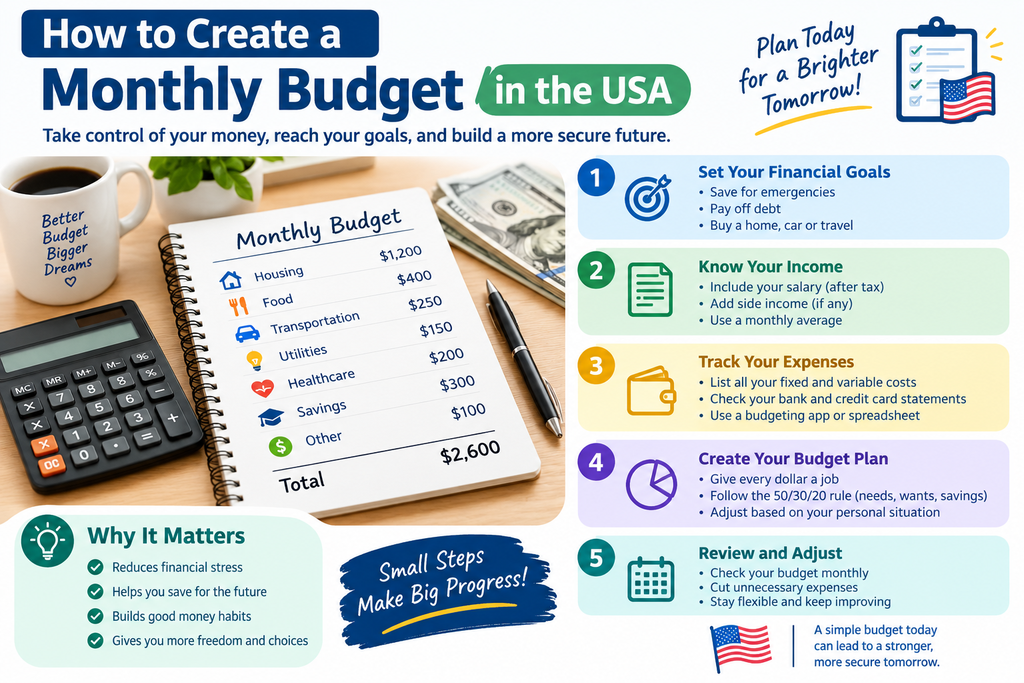
In this guide, you will learn how to create a monthly budget, understand common budgeting methods, review a sample American household budget, and discover practical ways to save money.
1.What Is a Monthly Budget?
Creating a monthly budget is an important step toward managing your money, controlling expenses, and reaching your financial goals. Learning how to create a monthly budget can help you understand where your income goes, prepare for upcoming bills, and build savings. In this guide, you will learn how to calculate monthly income, organize expenses, choose a budgeting method, and create a practical budget for life in the United States.
A monthly budget is a plan for how you will use the money you receive during a month. It helps you organize your income and decide how much to spend, save, and use to repay debt.
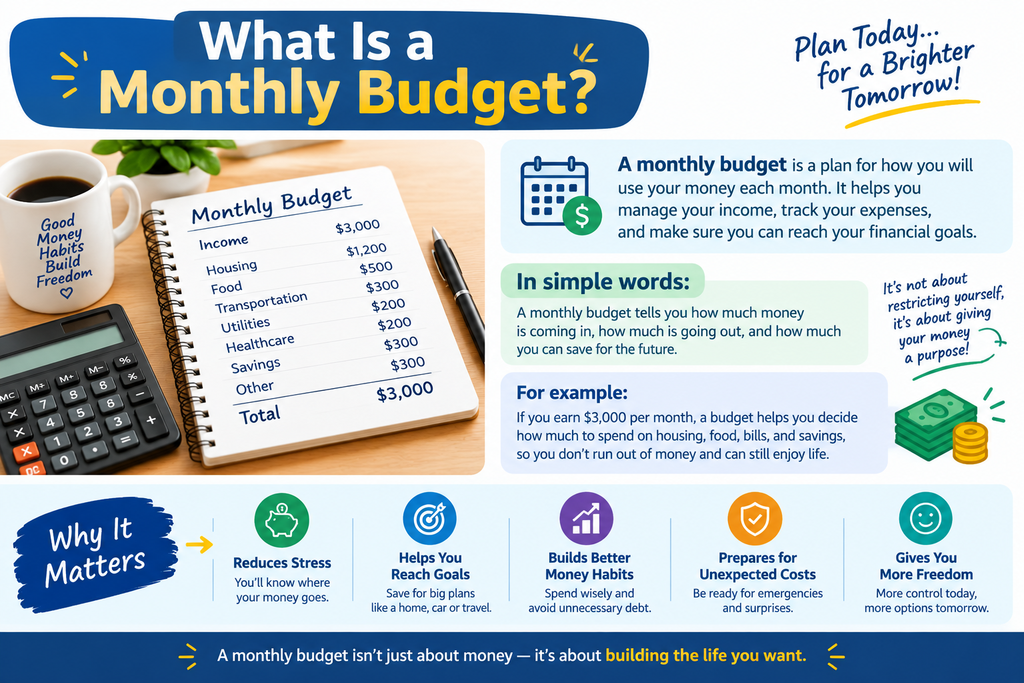
A budget generally includes three main elements:
- Income: Money you receive from employment, self-employment, benefits, or other sources.
- Expenses: Money you spend on housing, food, transportation, insurance, bills, and other needs.
- Savings and debt payments: Money set aside for emergencies, future goals, and outstanding debts.
A budget can help you identify unnecessary spending, prepare for upcoming bills, and avoid relying on credit cards for everyday expenses.
The goal is to make sure your spending fits your income while leaving room for your financial priorities.
How Does a Monthly Budget Work?
A monthly budget works by comparing the money you receive with the money you spend.
Follow these simple steps:
- Calculate your total monthly take-home income.
- List your fixed and variable expenses.
- Decide how much money to save.
- Set limits for optional spending.
- Review your budget at the end of each month.
- track your spending regularly.
- Prioritize essential bills and expenses.
- Set realistic savings goals.
- Avoid unnecessary subscriptions and impulse purchases.
- Make room for irregular expenses, such as car repairs.
- Review and update your budget every month.
- Use a spreadsheet, notebook, or budgeting app to stay organized.
A monthly budget is a simple but valuable tool for managing your money in the USA. By understanding your income, tracking your expenses, and setting realistic savings goals, you can develop better financial habits and work toward a more secure future.
Start with a simple plan today and improve it as your financial situation changes.
2.Why Is Budgeting Important in the USA?
Living expenses in the United States vary considerably depending on your location, household size, income, and lifestyle. Housing, transportation, healthcare, groceries, insurance, and debt payments can consume a substantial portion of a household’s income.
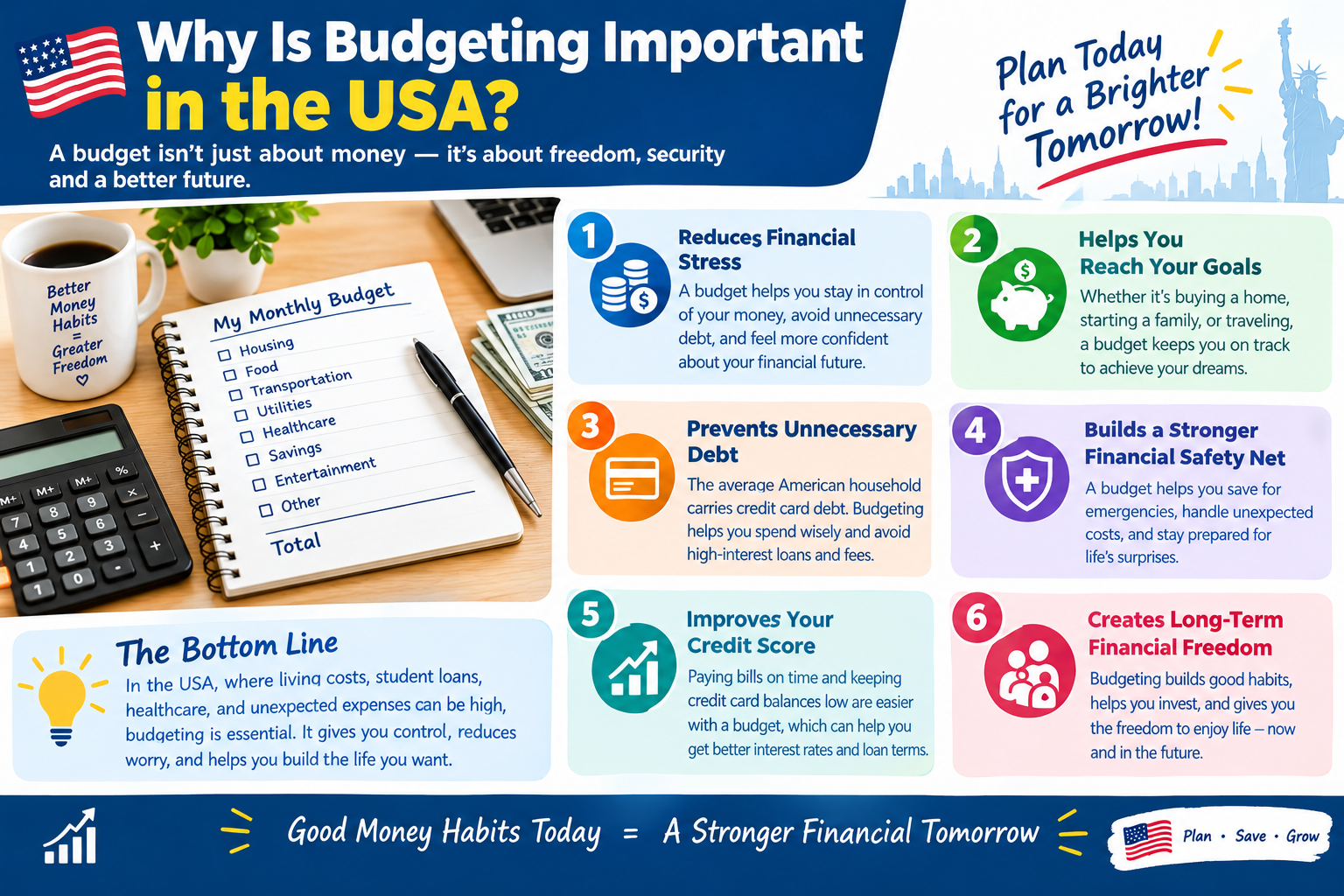
A monthly budget can help you:
- Understand your spending habits.
- Prepare for rent, mortgage payments, utilities, and other bills.
- Build an emergency fund.
- Plan for student loans, credit cards, and other debts.
- Save for a car, home, education, or retirement.
- Reduce unnecessary purchases.
- Prepare for unexpected expenses.
Step 1: Calculate Your Monthly Income
start by determining how much money you actually receive each month.
If you work for an employer, use your take-home pay rather than your salary before taxes and deductions.
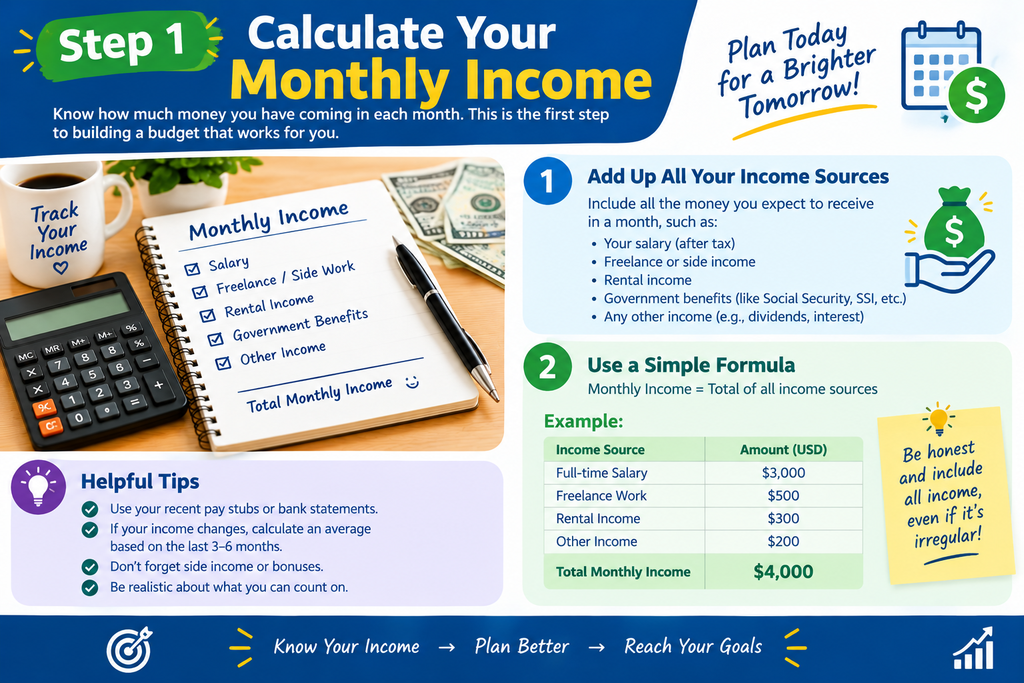
If you receive irregular income, such as commissions or freelance payments, review several months of earnings and use a cautious estimate. Avoid planning essential expenses around money you are not certain to receive.
Step 2: List Your Monthly Expenses
The next step is to identify where your money goes.
Review your bank statements, credit card statements, receipts, and bills from the previous one to three months.
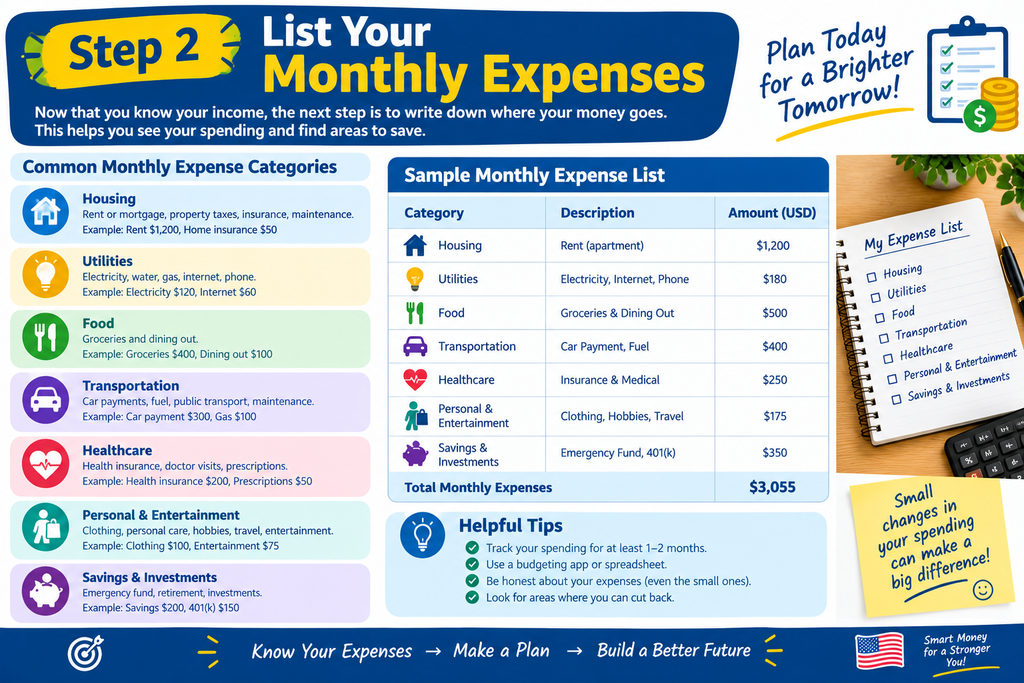
Divide your expenses into three categories.
Fixed Expenses
Fixed expenses are payments that usually remain relatively consistent.
Examples include:
- Rent or mortgage payments
- Car payments
- Insurance premiums
- Internet and phone plans
- Student loan payments
- Subscription services
Variable Expenses
Variable expenses change from month to month.
Examples include:
- Groceries
- Electricity and gas
- Fuel and public
- transportation
- Dining out
- Clothing
- Entertainment
Irregular Expenses
Some expenses occur only occasionally or vary throughout the year.
Examples include:
- Vehicle maintenance
- Medical expenses
- Annual insurance premiums
- Holiday spending
- School supplies
- Home repairs
Estimate how much these irregular expenses cost over a year and divide that amount by 12. Set aside that monthly amount when possible so you are better prepared when a bill arrives.
Step 3: Choose a Budgeting Method
There is no single budgeting method that works for everyone. Choose a system that fits your income, expenses, and financial goals.
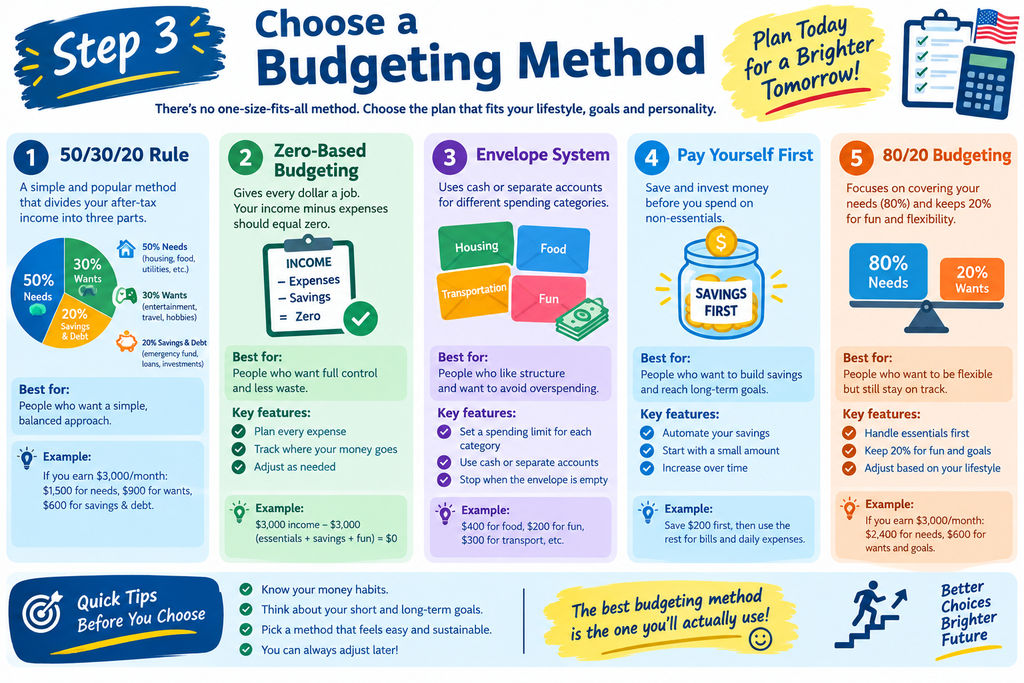
The 50/30/20 Budget Rule
The 50/30/20 rule divides take-home income into three broad categories:
- 50% for needs: Housing, basic groceries, utilities, essential transportation, and necessary insurance.
- 30% for wants: Entertainment, hobbies, dining out, and nonessential purchases.
- 20% for savings and debt goals: Emergency savings, retirement contributions, and additional debt repayment.
For someone receiving $4,000 per month after deductions, the guideline would look like this:
| Budget Category | Percentage | Monthly Amount |
| Needs | 50% | $2,000 |
| wants | 30% | $1,200 |
| Savings and debt goals | 20% | $800 |
| total | 100% | $4,000 |
These percentages are guidelines, not strict requirements. If you live in an expensive city or have substantial medical or childcare costs, your essential expenses may exceed 50%.
You can adjust the percentages to reflect your circumstances.
Zero-Based Budgeting
Zero-based budgeting means assigning a purpose to every dollar of your expected monthly income.
For example, if you receive $3,500, you allocate the entire amount to expenses, savings, debt payments, and other planned categories.
The goal is:
Monthly income − planned expenses and allocations = $0 unassigned.
This does not mean you must spend all your money. Savings and emergency-fund contributions are included as planned allocations.
This method is useful for people who want to monitor their money closely.
The Pay-Yourself-First Method
with this method, you transfer a planned amount into savings when you receive your income. You then use the remaining money to cover bills and other expenses.
For example, if your take-home pay is $3,000 and your savings target is $300, you set aside the $300 first and plan the remaining $2,700.
Make sure essential bills and minimum debt payments remain affordable.
Step 4: Create a Monthly Budget Plan
once you know your income, expenses, and preferred budgeting method, prepare a written plan.
Here is an illustrative monthly budget for a single adult living in the USA.
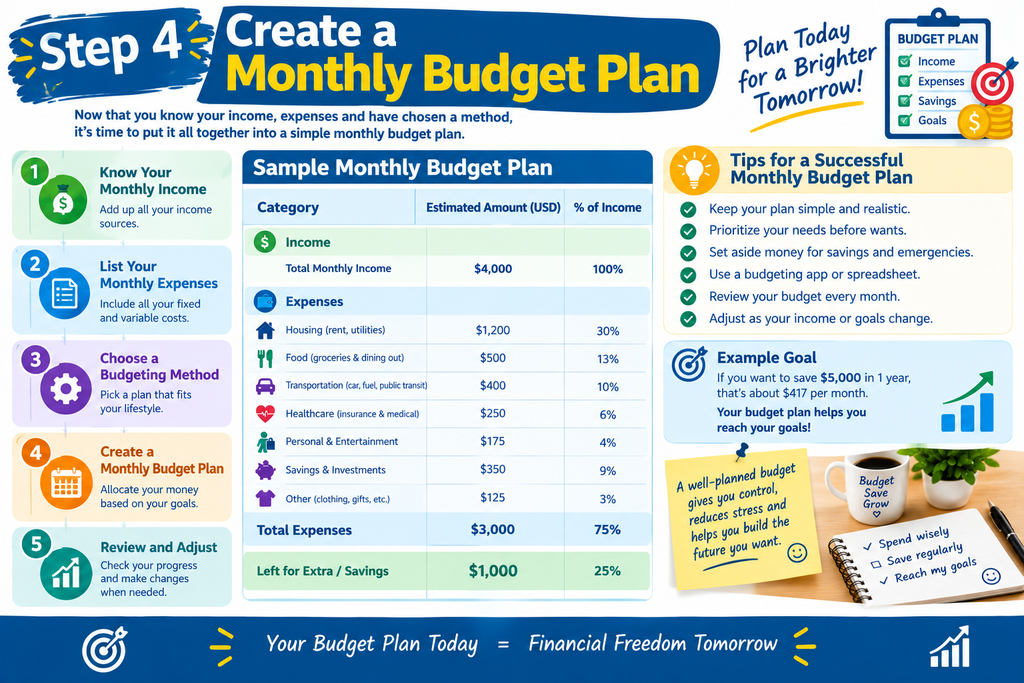
Actual expenses differ significantly across the United States. A household in a high-cost city may need a different allocation, and some people will have additional childcare, healthcare, or family-support expenses.
The example is intended to demonstrate the budgeting process, not to represent average American expenses or a recommended budget for every reader.
Step 5: Set Realistic Savings Goals
savings goals give your budget a clear purpose.
Instead of simply deciding to save more money, choose a specific target and timeframe.
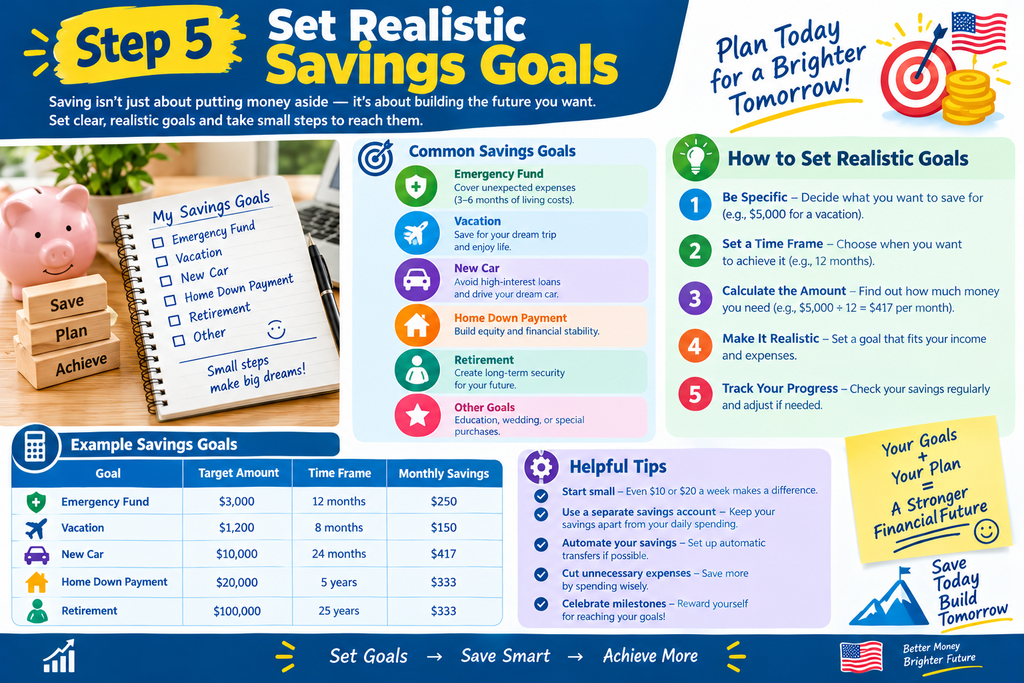
Examples include:
- Saving $500 for an upcoming bill.
- Building an emergency fund.
- Saving for a vehicle or home deposit.
- Preparing for education expenses.
- Increasing retirement contributions.
- Saving for a planned vacation.
Build an Emergency Fund
An emergency fund is money reserved for unexpected expenses, such as essential vehicle repairs, an urgent home repair, or a sudden loss of income.If you are starting from zero, begin with a manageable target.
Even a small amount can help you handle an unexpected bill without immediately turning to a credit card.
Over time, many people aim to build savings that could cover three to six months of essential expenses.
The appropriate amount depends on income stability, household responsibilities, insurance coverage, and other circumstances.
Keep emergency savings somewhere reasonably accessible and consider the account’s fees, withdrawal rules, and deposit protection.
Step 6: Manage Credit Card and Other Debt Payments
debt payments can affect how much money you have available for savings and everyday expenses.
Include at least the required minimum payment for each debt in your monthly budget.
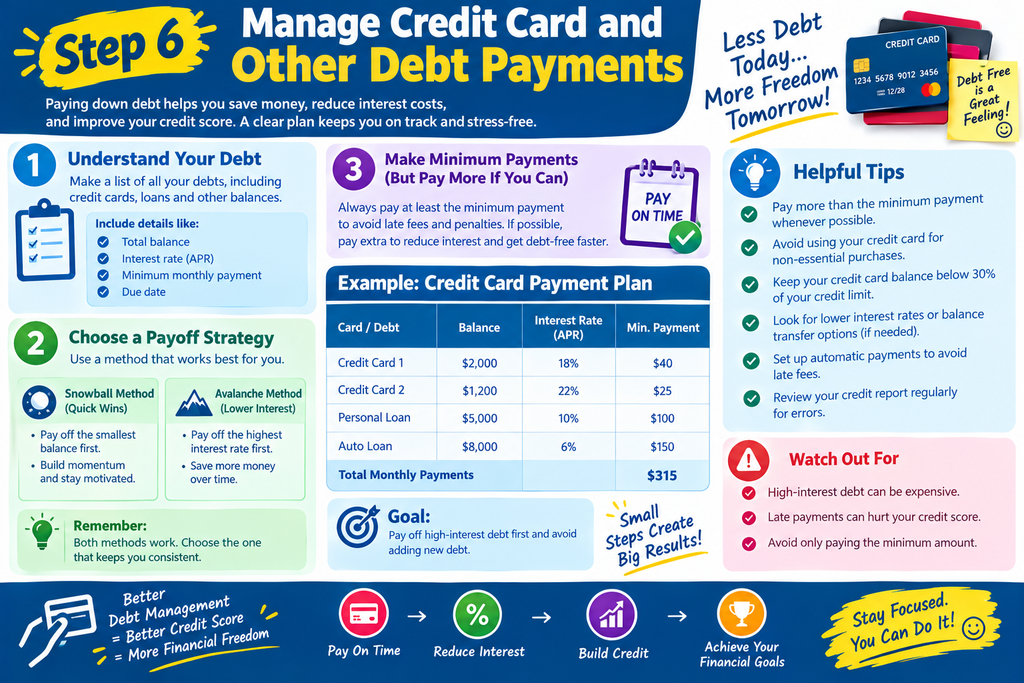
If you have several debts, consider these approaches:
Debt avalanche method: Pay the minimum required on each debt and direct additional money toward the debt with the highest interest rate. This approach can reduce interest costs when other factors are equal.
Debt snowball method: Pay the minimum required on each debt and direct additional money toward the debt with the smallest balance. This can help some people stay motivated by seeing balances disappear.
Continue making required payments on all accounts. Before choosing a repayment strategy, consider interest rates, fees, promotional terms, and any special repayment conditions.
Avoid treating available credit card limits as additional income. Credit cards are borrowed money, and carrying a balance can lead to interest charges.
For related information, read our guide: Best Credit Cards in the USA for Beginners
Best Credit Cards in USA for Beginners (2026 Guide).
Step 7: Reduce Unnecessary Monthly Expenses
Review your spending and identify expenses that do not provide enough value for their cost.
Consider these practical steps:
- Review recurring subscriptions and cancel services you no longer use.
- Compare phone and internet plans.
- Plan meals before shopping for groceries.
- Prepare meals at home when practical.
- Compare insurance coverage and premiums before switching providers.
- Use a shopping list to reduce impulse purchases.
- Set a monthly limit for dining out and entertainment.
- Review bank account fees and avoidable charges.
- Compare transportation costs when choosing how to travel.
- Wait before making nonessential purchases.
Do not automatically cut essential insurance, medical care, or other important services simply to meet a savings target. Compare the costs and consequences before changing coverage.
Step 8: Track Your Spending Every Week
Creating a budget is only the beginning.You must also check whether your actual spending matches your plan.
Choose a tracking method that you can maintain.
Use a Budgeting App
Budgeting applications may help you categorize transactions, monitor bills, and track savings goals. Review any app’s fees, privacy practices, and account-access permissions before connecting financial accounts.
Use a Notebook
If you prefer a simple approach, record your income and expenses in a notebook. Update it after purchases and review the totals at the end of each week.The best method is one you will use consistently.
Step 9: Adjust Your Budget When Circumstances Change
A budget should change when your financial circumstances change.
You may need to revise your plan if:
- Your income increases or decreases.
- Your rent changes.
- You move to another city.
- You have a new family responsibility.
- Insurance premiums increase.
- You receive an unexpected bill.
- You pay off a loan.
If your essential expenses exceed your available income, review the largest expenses first and consider practical changes. Avoid assuming that every expense can be reduced immediately.
For people with irregular earnings, prepare a budget around essential expenses and maintain a cash reserve when possible.
3.Common Monthly Budgeting Mistakes to Avoid
Even a simple budget can become difficult to maintain if it does not reflect real spending.
Avoid these common mistakes:
1. Forgetting irregular expenses: Annual bills, repairs, and holiday spending should be considered in advance.
2. Underestimating groceries and transportation: Use actual spending history instead of unrealistic targets.
3. Setting overly strict limits: A budget that leaves no room for reasonable personal spending may be difficult to follow.
4. Ignoring small purchases: Frequent low-cost purchases can add up over time.
5. Missing debt payments: Budget for required payments and their due dates.
6. Giving up after one difficult month: Review what went wrong and adjust the next month’s plan.
7. Treating savings as leftover money: When possible, make savings a planned budget category.
Consumer Financial Protection Bureau (CFPB)
Helpful information about budgeting, saving, and managing money.
CFPB budgeting resourceshttps://www.consumerfinance.gov/consumer-tools/budgeting/
Conclusion
Learning how to create a monthly budget in the USA can help you understand your spending, prepare for bills, manage debt, and work toward financial goals.
Start by calculating your take-home income and listing your expenses. Choose a budgeting method that fits your needs, set realistic savings targets, and review your spending every week.
You do not need a perfect budget on the first attempt. Small, consistent improvements can help you build better money-management habits over time.
Create a Successful Monthly Budget in the USA (2026 Guide)
Explore more personal finance guides onBest Credit Cards in the USA for Beginners. Secure Money Credit USA to learn about credit cards, credit scores, loans, insurance, banking, and investing.
Disclaimer:
This article is provided for general educational and informational purposes only. It is not personalized financial, tax, legal, or investment advice. Individual financial circumstances vary, and readers should evaluate their own needs before making financial decisions.