How to Open a Bank Account in the USA (2026 Guide)
Opening a bank account is an important step toward managing your money, receiving your income, paying bills, and building a strong financial foundation.
A bank account can help you organize everyday expenses, save for future goals, and access convenient financial services.However, choosing the right account can be confusing for beginners.
You may wonder which documents you need, how much money you must deposit, whether you can apply online, or whether you need a Social Security number.
In this guide, we explain how to open a bank account in the USA, the different types of accounts available, common eligibility requirements, potential fees, and important safety considerations.
Whether you are opening your first account or comparing banking options, this article will help you understand the process and make an informed decision.
1.What Is a Bank Account?
A bank account is a financial account that allows you to deposit, store, and manage money through a bank or another eligible financial institution.
Depending on the account type, you may be able to receive direct deposits, pay bills, transfer money, withdraw cash, use a debit card, and earn interest on your balance.
Many people use bank accounts to manage their monthly income and expenses. For example, an employee may receive their salary through direct deposit, use a checking account to pay rent, and transfer some money into a savings account for emergencies.
Bank accounts can make everyday financial management easier, but it is important to understand their fees, conditions, and features before opening one.
2.Types of Bank Accounts in the USA
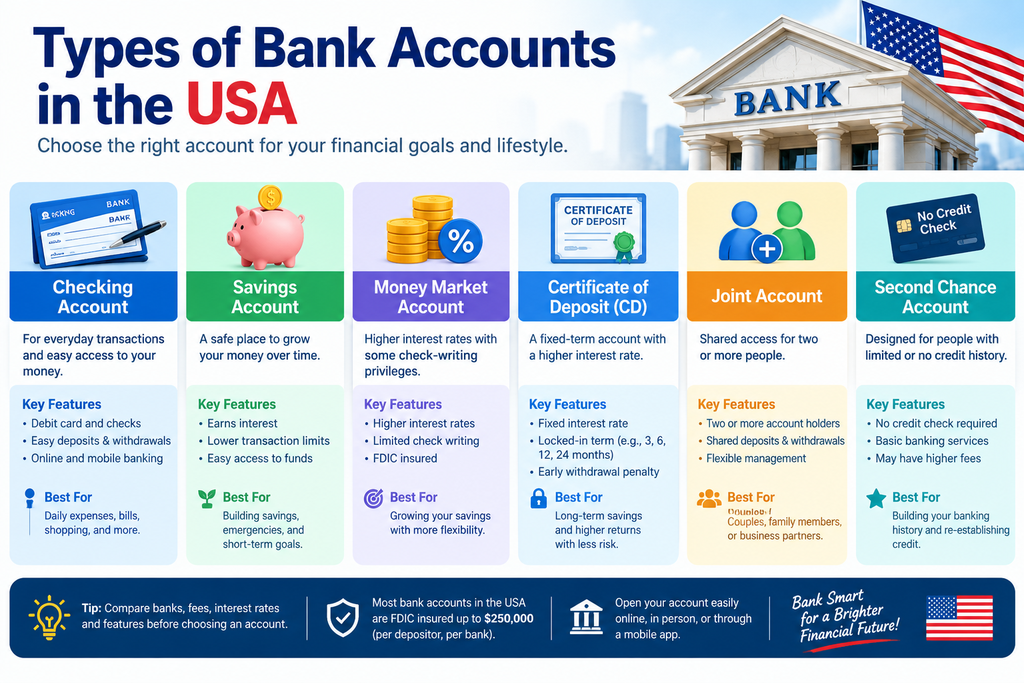
Before applying for an account, understand the main options available.
Types of Bank Accounts in the USA.”
1. Checking Account
A checking account is generally designed for everyday financial transactions.
Common features include:
- Depositing your paycheck.
- Paying rent and utility bills.
- Using a debit card for purchases.
- Withdrawing cash from ATMs.
- Sending electronic payments.
- Setting up automatic bill payments.
Checking accounts may charge monthly maintenance fees, overdraft fees, out-of-network ATM fees, or other service charges. Some accounts offer ways to avoid certain fees, such as maintaining a qualifying balance or receiving eligible direct deposits.
How to open a checking account
A checking account may be a good choice if you regularly receive income and pay everyday expenses.
2. Savings Account
A savings account is generally designed to help you set aside money for future needs.
Common uses include saving for emergencies, planned purchases, education, or other financial goals.
Depending on the account, you may earn interest on your balance. Interest rates and account conditions vary among financial institutions and can change over time.
Before opening a savings account, compare its annual percentage yield (APY), minimum balance requirements, monthly fees, withdrawal conditions, and deposit insurance coverage.
A savings account may be useful if you want to keep some money separate from your everyday spending funds.
3. Student Bank Account
Some financial institutions offer accounts designed for eligible students or young customers.
These accounts may have reduced fees, age-based benefits, or features designed for people who are beginning to manage money independently.
Eligibility varies by institution. You may need to provide proof of age, student status, or a parent or guardian’s participation if you are a minor.
Read the account terms carefully before applying.
4. Joint Bank Account
A joint bank account is owned by two or more people, depending on the account agreement.
Joint accounts may be useful for spouses, partners, or family members who want to manage shared expenses.
However, joint ownership can have important legal and financial consequences.
Each account holder may have access to the funds, and one person’s transactions or overdrafts can affect the account.
Before opening a joint account, understand each person’s rights, responsibilities, and access to the money.
5. Online Bank Account
An online bank account can be opened and managed through a website or mobile application, depending on the institution.
Some online accounts offer low fees or convenient digital tools. However, not every online banking product has the same services, deposit options, or customer support arrangements.
Check whether the institution is a bank or works with a partner bank, and verify which entity provides any deposit insurance.
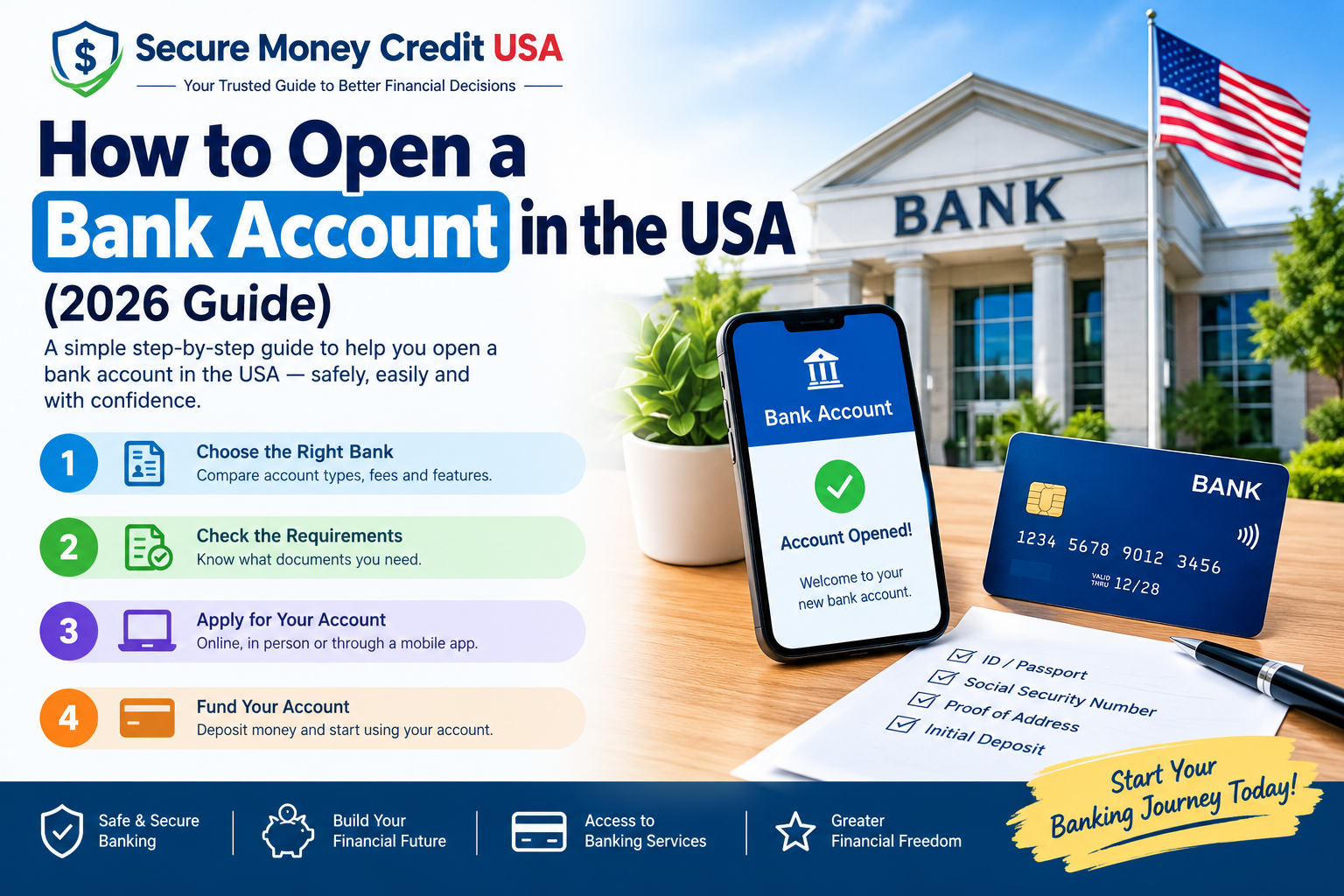
3.How to Open a Bank Account in the USA: Step-by-Step Guide
Opening a bank account usually involves selecting an account, providing identifying information, completing an application, and making any required initial deposit.
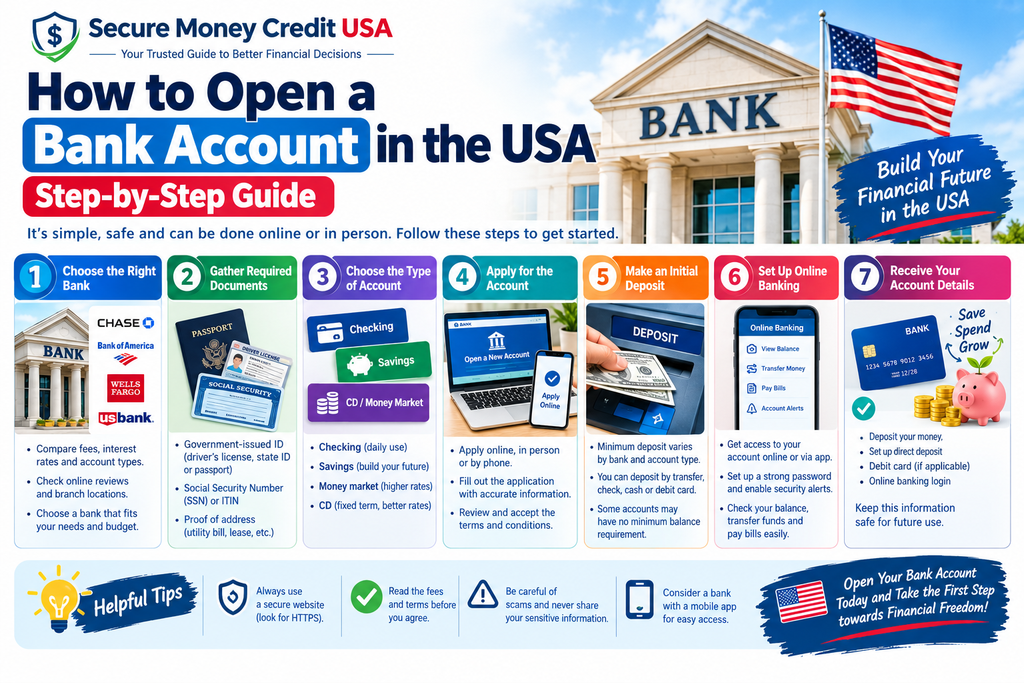
Step 1: Choose the Right Bank
Start by comparing banks and credit unions that serve your needs.
Consider the following factors:
- Monthly maintenance fees.
- Minimum opening deposit.
- Minimum balance requirements.
- ATM access and fees.
- Mobile and online banking services.
- Customer service availability.
- Interest rates on savings accounts.
- Overdraft policies.
- Deposit insurance coverage.
Do not choose a bank based only on advertising or a promotional offer. Review the official account disclosures before applying.
You can begin your research using the Federal Deposit Insurance Corporation’s consumer banking resource:
FDIC GetBanked: https://www.fdic.gov/getbanked
Step 2: Select Checking or Savings
Decide how you intend to use the account.
If you need an account for receiving paychecks, paying bills, and making frequent transactions, a checking account may be appropriate.
If you want to set money aside and potentially earn interest, consider a savings account.
Some people use both accounts to separate everyday spending from savings.
Step 3: Gather the Required Documents
Banks must follow customer identification requirements. The exact documents accepted can vary by institution, account type, and application method.
You may need some or all of the following:
- Your full legal name.
- Date of birth.
- Residential or other qualifying physical address.
- Social Security number (SSN), Individual Taxpayer Identification Number (ITIN), or another identification number accepted under the applicable rules.
- Government-issued photo identification.
- Proof of address, if requested.
- Contact information, such as a telephone number or email address.
Examples of identification documents that some banks accept include a U.S. driver’s license, state identification card, U.S. passport, or foreign passport.
Some institutions accept additional forms of identification, but acceptance is not universal.
Before visiting a branch or starting an online application, check the bank’s official list of required documents.
Step 4: Check Whether You Need an SSN or ITINA
Social Security number is commonly requested when opening a U.S. bank account, particularly for online applications.
However, a Social Security number is not universally required to open every checking or savings account.
Some banks and credit unions accept an Individual Taxpayer Identification Number (ITIN). Others may accept specified government-issued identification numbers, such as a foreign passport number and country of issuance, subject to their procedures and applicable law.
Do not assume that every bank accepts an ITIN or passport instead of an SSN.
Contact the institution before applying if you do not have an SSN.
For official information, see the Consumer Financial Protection Bureau’s guidance on opening an account without a Social Security number or driver’s license:
https://www.consumerfinance.gov/
Step 5: Provide Proof of Address
many banks ask for a residential or other qualifying physical address.
Depending on the institution, acceptable supporting documents may include:
- A recent utility bill.
- A lease or rental agreement.
- A bank or financial statement.
- A qualifying government document.
- Another document specified by the bank.
Requirements differ. Some banks can verify your address electronically, while others may ask you to provide supporting documents.
A post office box alone may not satisfy a bank’s residential-address requirements.
If you have recently moved, ask the bank what alternative documents it accepts.
Step 6: Complete the Application
Depending on the bank, you may apply:
- Online through its official website.
- Through its official mobile application.
- In person at a branch.
You will generally provide personal information and answer questions needed to verify your identity and determine your eligibility.
Review every field before submitting the application. Your name, date of birth, address, and identification information should match the relevant documents.
Never provide false information to meet an account requirement.
If an online application cannot verify your identity electronically, the bank may ask you to visit a branch or provide additional information.
Step 7: Make the Initial Deposit, If Required
Some accounts require an opening deposit, while others allow you to open an account with no initial deposit.
The amount depends on the financial institution and the specific account.
For example, one account might require an initial deposit, while another might have no minimum opening deposit but impose other conditions.
Before transferring money, confirm:
- The minimum opening deposit.
- Accepted deposit methods.
- Any minimum ongoing balance.
- Conditions for avoiding monthly fees.
- Whether deposited funds will be immediately available.
Do not assume that every bank requires the same amount.
Step 8: Review the Account Agreement and Fees
Before finalizing the application, read the account agreement and fee schedule.
Pay particular attention to:
Monthly maintenance fees: Some accounts charge a recurring fee unless you meet specified conditions.
Overdraft fees: Depending on the account and transaction type, spending or payments that exceed your available balance may result in fees or declined transactions.
ATM fees: Using an out-of-network ATM may result in charges from the ATM operator, your financial institution, or both.
Wire transfer fees: Some banks charge fees for sending or receiving wire transfers.
Other service fees: Paper statements, cashier’s checks, stop-payment requests, or other services may involve charges.
Ask questions if you do not understand a fee or account condition.
Step 9: Activate Your Account
Once the bank approves your application, follow its instructions to activate the account and related services.
Depending on the institution, you may need to:
- Set up online banking
- Create secure login credentials.
- Activate your debit card.
- Set up account alerts.
- Review transaction notifications.
- Add a trusted payment method.
- Arrange direct deposit, if needed.
Use a strong, unique password and enable multifactor authentication when available.
Never share your password, one-time verification codes, or banking credentials with someone who contacts you unexpectedly.
Step 10: Manage Your Money Responsibly
After opening your account, check your balance and transactions regularly.
Useful habits include:
- Tracking your income and spending.
- Setting up alerts for large transactions.
- Reviewing statements for unfamiliar activity.
- Keeping enough money available for scheduled payments.
- Avoiding unnecessary fees.
- Reporting lost cards or suspicious transactions promptly.
These habits can help you maintain better control over your finances.
4.What Documents Do You Need to Open a Bank Account?
The following table provides a general overview. Your chosen institution may require additional documents.
Documents Required to Open a Bank Account in the USA
- 1. Identity Proof: Driver’s license, state ID, or passport. Accepted documents vary by bank.
- 2. Identification Number: Social Security Number (SSN), Individual Taxpayer Identification Number (ITIN), or another permitted number, depending on bank policies.
- 3. Proof of Address: Residential or qualifying physical address. Additional documents may be required.
- 4. Date of Birth: Accurate date of birth matching your identification documents.
- 5. Contact Details: Phone number and email address for communication and identity verification.
- 6. Opening Deposit: Initial deposit through an accepted method, such as a bank transfer or cash at a branch. Some accounts do not require an opening deposit.
- 7. Additional Documents: Student documentation or other identification documents, when applicable. Requirements depend on your circumstances and the bank’s policies.
- Note: Requirements vary by financial institution. Check the bank’s official website before applying.
The best option depends on your goals. Review the terms of each account rather than assuming all checking or savings accounts offer the same features.
5.How to Choose a Bank Account With Low Fee
A low-fee account can help you keep more of your money.
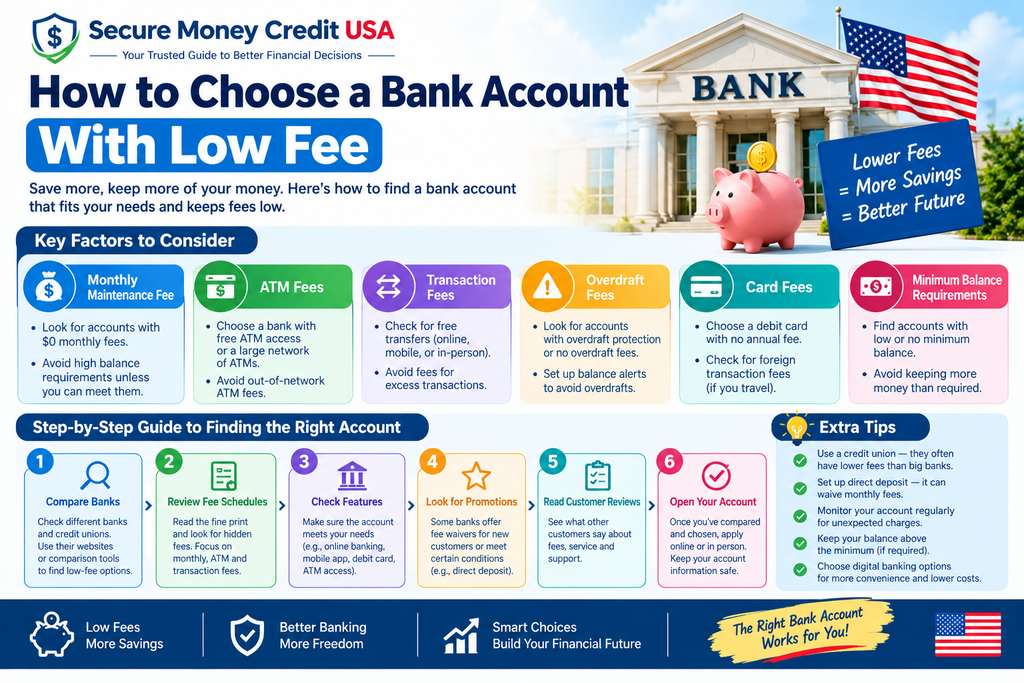
Here are some factors to compare before applying.
1. Look for No-Monthly-Fee Options
Some accounts do not charge a monthly maintenance fee. Others waive the fee when you meet specified conditions.
Confirm that you can realistically meet any conditions before opening the account.
2. Check ATM Access
If you frequently withdraw cash, look for an account with convenient ATM access.
Check whether your bank charges out-of-network ATM fees and whether the ATM operator may charge a separate fee.
3. Understand Overdraft Policies
an overdraft can occur when a transaction exceeds your available balance.
Ask how the bank handles overdrafts, whether fees may apply, and what options exist for declining transactions or avoiding overdraft charges.
Debit-card overdraft coverage and other types of transactions may be treated differently.
4. Compare Savings Rates
If you plan to keep money in a savings account, compare APYs and account conditions.
An advertised rate may change, and some accounts have minimum balance requirements or other restrictions.
5. Review Customer Support
consider whether the bank offers the support you need, including phone assistance, secure messaging, branch access, or other service options.
Good support can be especially valuable if you experience a payment problem or suspicious transaction.
6.Is Money in a U.S. Bank Account Safe?
Eligible deposits at an FDIC-insured bank are generally protected by federal deposit insurance, subject to applicable limits and requirements.
The standard FDIC insurance limit is $250,000 per depositor, per insured bank, for each account ownership category.
Coverage is determined by ownership category and other applicable rules, not simply by the number of accounts a person has.
Credit unions may have separate federal deposit insurance through the National Credit Union Administration (NCUA), if they are federally insured.
Before opening an account, verify the institution and understand which entity holds your deposits.
FDIC insurance does not cover every financial product. For example, stocks, bonds, mutual funds, and crypto assets are not FDIC-insured deposits.
For more information, visit:
https://www.fdic.gov/resources/deposit-insurance
7.What Happens if a Bank Rejects Your Application?
A bank may decline an application if it cannot verify your identity, if required documents are missing, or if its account-opening policies do not permit the application.
Some banks also review information about an applicant’s previous checking-account history.
If your application is rejected, consider these steps:
- Ask the bank for the reason, where available.
- Check whether you submitted accurate information.
- Ask whether additional documents would resolve the issue.
- Review relevant consumer reports if the bank used them.
- Dispute inaccurate information with the appropriate reporting company.
- Consider another institution with different eligibility requirements.
Second-chance accounts may provide access to basic banking services, but they can have restrictions or fees. Compare their terms carefully.
8.Common Mistakes to Avoid When Opening a Bank Account
Avoid these common mistakes when selecting and opening an account.
Ignoring fees: A bank account with no opening deposit may still charge monthly fees or other service charges.
Providing incorrect information: Inconsistent or inaccurate information can delay identity verification.
Assuming every bank accepts the same documents: Identification policies vary.
Overlooking overdraft terms: Understand what happens if you spend more than the available balance.
Using unofficial websites: Apply through the financial institution’s verified website or official application.
Sharing sensitive information: Never disclose passwords or verification codes to unexpected callers or messages.
Failing to monitor transactions: Review your account regularly and report suspicious activity promptly.
Conclusion
Opening a bank account in the USA can be an important step toward managing your money more effectively.
Start by choosing an account that matches your needs, reviewing the bank’s eligibility requirements, gathering the required identification documents, and comparing fees and account conditions.
You may be able to apply online or visit a branch, depending on the financial institution and your circumstances.
If you do not have a Social Security number or are not a U.S. citizen, contact the bank to confirm which alternative documents it accepts.
Take time to understand the account agreement, check deposit insurance coverage, and monitor your transactions after opening the account.
With careful research, you can choose a banking option that supports your everyday financial needs and longer-term goals.
1. FDIC — GetBankedUse for: How to open an account, account-opening steps, and basic banking information.
Official resource: FDIC GetBanked
Some personal financial information Personal finance guide for beginners in the USA
Disclaimer:
This article is provided for general educational and informational purposes only. It is not legal, tax, immigration, or financial advice. Bank requirements, fees, eligibility rules, and account terms vary by institution and may change. Verify current information directly with the bank or relevant U.S. government agency before making a decision.